Introduction
There’s so much we don’t understand.
Astronomers can map out the galaxies and systematize the stars, but where is heaven? Doctors can transplant the heart and plot the regions of the brain, but where is the seat of the human soul?
As Theodora Ward writes in Men and Angels, “No one has yet discovered by scientific methods a location for spirit, though the acts of spirit can be discerned by those who are open toward them.”
And this is the realm of angels. On their long sweeping wings, they gracefully bear the weight of the intangible.
In the Bible, angels are God’s messengers, as the Greek word angelos and the Hebrew mal’ak both indicate. And since the Middle Ages, they generally have been thought of as personified powers mediating between the mortal world and the Divine. Biblical stories portray them as intercessors, bearers of good news, assuagers of fear and guardians from harm.
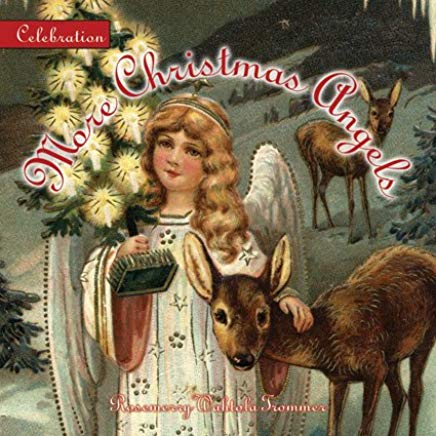
In this collection of Christmas cards, the angels summon us to a joyful Christmas, creating a relationship between earthly tasks and a spiritual celebration. They remind us that at its heart Christmas is beyond an earthbound festival; it honors a miracle. On some cards they seem to revel in the holiday duties of our temporal world: lighting candles, cutting evergreen trees, and bringing forth flowers, fruits and gifts. On other cards the angels offer us a glimpse of unknowable wonders. We witness their unearthly splendor as they guard the crèche, play carols on their instruments and befriend animals in the woods. The late-nineteenth- and early twentieth-century artists who fashioned these cards depict them as our Yuletide partners, the harbingers of the season.
The tradition of sending written Christmas cards to loved ones coevolved in England and the United States in the 1840s as a way for people in the modernizing society to keep in touch with distant family members and friends. It is one of the few contemporary Christmas traditions without religious roots, and artists reflected this in their first Christmas card designs. They chose to depict earthly delights, such as sunny days, flowers and adorable children, or to emphasize the holiday’s lay traditions by showing large feasts and happy families.
Who were the artists behind these lovely antiques? Many were uncredited and so, unjustly, unsung. But the works of a few lithographer-printers, particularly Raphael Tuck & Sons of London, who provided Queen Victoria with Christmas cards, and Louis Prang of Boston, have become sought after. Both Tuck and Prang began producing Christmas cards in the early 1870s, and examples of their work are included in this collection.
Around 1890, the Christmas card was influenced by a deep cultural fascination with angels. The angel experienced a figurative heyday as artists and authors experimented with new uses and flourishes for the symbol. Soon the winged beings came to spectacularly enrich the previously secular holiday scenes.
Experimentation in the look of angels was nothing new. Though angels have augmented the Christian visual vocabulary since the fourth century, A.D., their appearances have changed radically. It wasn’t until the 6th century that artists typically included wings and a nimbus in angel renderings. Another major modification occurred during the Renaissance when the previously masculine, authoritative-looking figures were rendered with increasing frequency as females. By the 1800s, the word “angelic” usually referred to women, and artists portrayed angels as the epitome of feminine grace: rosy-cheeked and creamy-skinned. Cherubs also underwent a face lift around this time: the apocalyptic animal faces of Ezekiel’s cherubim emerged in the 19th century as chubby-cheeked, flaxen-haired angels with stunted wings.
The angels in this treasury reflect the popular imagination of the artists of their time. They emanate innocence, beauty, sweetness and joy. They extend delight to the eye and balm to the soul, inviting us to participate in the awe of Christmas.
The cards on the following pages date from 1878 to 1925 and hail from the United States, the United Kingdom, the Netherlands, Germany, Austria, Denmark, Sweden, Russia, Italy and France. Some were printed in Germany for export. This collection reproduces cards that were printed in Europe but mailed in Australia or North America. (In the back of this book, we note the place and year of each card’s origins or where it was posted, when it’s known, or anything else of interest that you can’t see.)
Christmas can be overwhelming. That isn’t the point. Encouraged by these Christmas angels, may we, too, find the thrill in heralding the season with our loved ones—singing carols, decorating our homes, exchanging gifts, celebrating the spirit of the season and looking for good news to share.
—Rosemerry Wahtola Trommer, Telluride Colorado